Major EE Swales
Edwin Essery Swales
- Rank
- Captain
- Later rank
- Major
- Honours
- VC DFC
- Squadron
- No 582 Squadron
- School
- Durban High School
- 1943 voyage
-
Sailed from Cape Town on the Rangitata in September 1943, and signed the group photograph taken in Montevideo on the way.
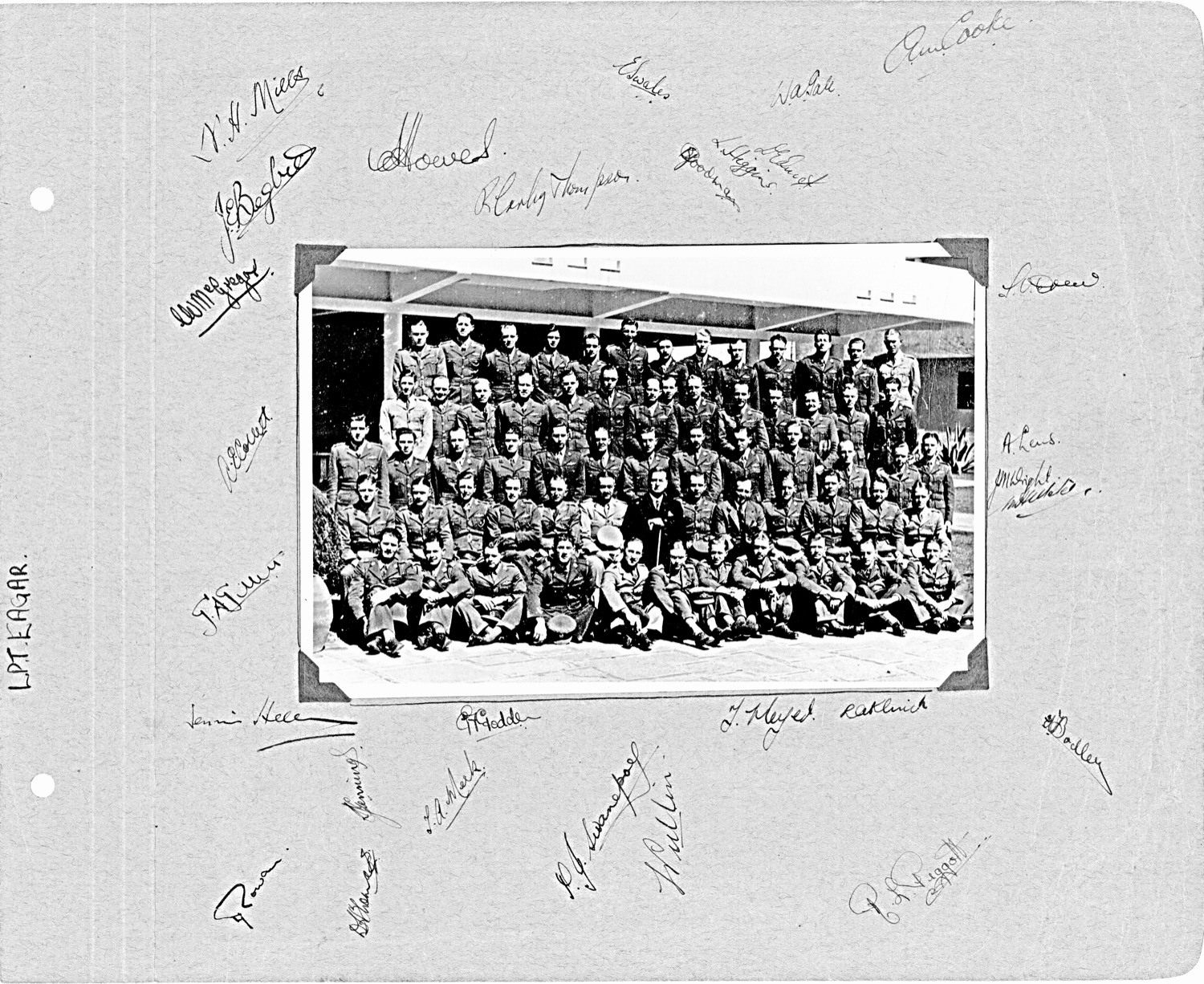 The story of the photograph
- Fate
- Killed in action, 24 February 1945
- In the book
- Pages 89, 127, 139, 144, 168
Stories that mention him
- South Africans overlooked at the Bomber Command MemorialSpirits in the Sky
From the book
Against Unfavourable Odds
Geoffery David Leybourne Haysom, Durban born and DHS educated where he was a few years behind Edwin Swales and WS Bowyer, commissioned in 1937 at the age of 20 and flew Hurricanes in France. Haysom served with No 79 Squadron during the “Battle of Britain”, accounted for two enemy aircraft in August, crash landed after combat on September 1st but back flying two days later. A page from his RAF “Pilots Flying Logbook” offers some insight as to what young airmen endured at the time.
More than a “Few” South Africans
JJ “Chris” Le Roux is one of 169 names recorded on the “Roll of Honour”, at Durban High School. More commonly known as DHS, the names include six other RAF airmen as well as seconded SAAF pilots Major’s Edwin Essery Swales and Eric Cowley Saville.
More than a “Few” South Africans
Edwin Swales served with the Natal Mounted Rifles in North Africa before joining the SAAF for flying training at the beginning of 1942. He received his wings in June 1943, volunteered for service with the RAF in August and was part of the group of seconded SAAF pilots who sailed from Cape Town on the “Rangitata” in September.
More than a “Few” South Africans
“The KING has been graciously pleased to confer the VICTORIA CROSS on the undermentioned officer in recognition of most conspicuous bravery:- Captain Edwin Swales DFC (6101V), SAAF,582 Sqn (deceased). Captain Swales was “master bomber” of a force of aircraft which attacked Pforzheim on the night of February 23rd 1945. As “master bomber” he had the task of locating the target area with precision and giving aiming instructions to the main force of bombers following in his wake. Soon after he had reached the target area he was engaged by an enemy fighter and one of his engines was put out of action. His rear guns failed. His crippled aircraft was an easy prey to further attacks. Unperturbed, he carried on with his allotted task; clearly and precisely he issued aiming instructions to the main force. Meanwhile the enemy fighter closed the range and fired again. A second engine of Captain Swales’ aircraft was put out of action. Almost defenceless, he stayed over the target area, issuing his aiming instructions until he was satisfied that the attack had achieved its purpose.It is now known that the attack was one of the most concentrated and successful of the war. Captain Swales did not, however regard his mission as completed. His aircraft was damaged. Its speed had to have been so much reduced that it could only with difficulty be kept in the air. The blind flying instruments were no longer working. Determined at all costs to prevent his aircraft and crew from falling into enemy hands, he set course for home. After an hour he flew into thin layered cloud. He kept his course by skilful flying between the layers, but later heavy cloud and turbulent air conditions were met. The aircraft, by now over friendly territory, became more and more difficult to control; it was losing height steadily. Realising the situation was desperate, Captain Swales ordered his crew to bale out. The time was very short and it required all his exertions to keep the aircraft steady while each of his crew moved in turn to the escape hatch and parachuted to safety. Hardly had the last crew- member jumped when the aircraft plunged to earth. Captain Swales was found dead at the controls. Intrepid in the attack,courageous in the face of danger, he did his duty to the last, giving his life that his comrades might live”
The Dreaded Telegram
Five pilots from the “Rangitata” group were killed in February. Lt Charles McGregor a No 97 Squadron Pathfinder pilot and 14 other aircrew died in a mid-air collision with another Lancaster over the Dortmund Ems Canal on February 8th. No 630 Squadron Lancaster pilot Lt GR Lacey and his crew lost their lives on February 15th, No 183 Squadron Typhoon pilots Captain Anton Lens and Lt Alan Hill died on the 22nd, No 582 Squadron Pathfinder pilot Captain Edwin Swales lost his life on February 23rd
SAAF Airmen in RAF Squadrons
Major Edwin Swales, one of thirteen SAAF pilots who flew Lancaster bombers and arguably the best-known seconded SAAF airmen, earned an immediate “Distinguished Flying Cross” two months before his posthumous “Victoria Cross” deed. Four served on No 630 Squadron and nine were spread over five other squadrons. Five lost their lives, seven including Swales, were awarded the “Distinguished Flying Cross”
A Different Kind of Enemy Flak
A general amnesty saw the release of Robey Leibbrandt, a South African Olympic boxer turned German spy and saboteur who was serving a life sentence after being found guilty of treason in 1943. In what seemed a contradiction in terms, Minister Erasmus agreed to the SAAF War Memorial, funded by the SAAF Association, and unveiled in May 1950 by Mrs O Swales mother of Major Edwin Swales VC DFC.
A Different Kind of Enemy Flak
Names like “Sailor “Malan, “Pat” Pattle, JD Nettleton, Robin Johnson and Edwin Swales are virtually unknown to an electronically indulged generation of South Africans with little or no interest in the Second World War.